- The Roundup
- Posts
- Chasing the Bounce
Chasing the Bounce
Stop waiting for THE bottom and just dive in (the water's fine).

Hector Alvero
March 03, 2026
Happy Tuesday, fellow Bitcoiners.
Missiles hit Tehran on Saturday and Bitcoin immediately dropped to $63,000. Then it bounced to $68,000. Then it pulled back again.
Right on cue, everyone started asking: "Is this the bottom?"
Better question: “Why are you trying to catch a falling knife when everyone with conviction is just stacking through the chaos?”
Here's what we're covering in the newsletter this week:
Why chasing bounces is a losing game
Bitcoin’s underlying fundamentals
Who's left buying at these levels
1. Trying to Time the Bounce
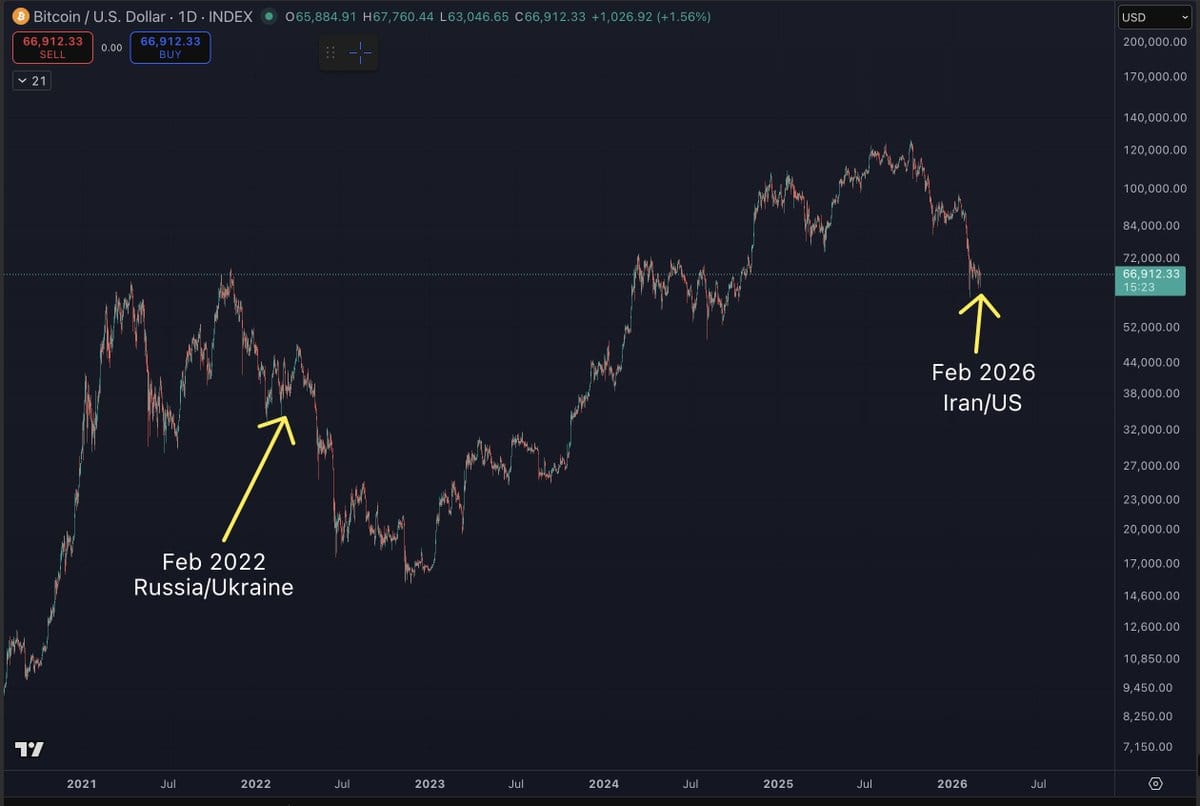
Benjamin Cowen laid it out this week:
"Risk assets sell off, then bounce as major conflicts start. If a rally does materialize, it will likely yield a lower high in March, just like it did in 2022. Bear markets tend to take a while to play out".
February 2022: Russia invades Ukraine, Bitcoin bounces, then grinds lower for months. February 2026: US strikes Iran, Bitcoin bounces... and now what?
History rhymes. Stop trying to time the bounce!
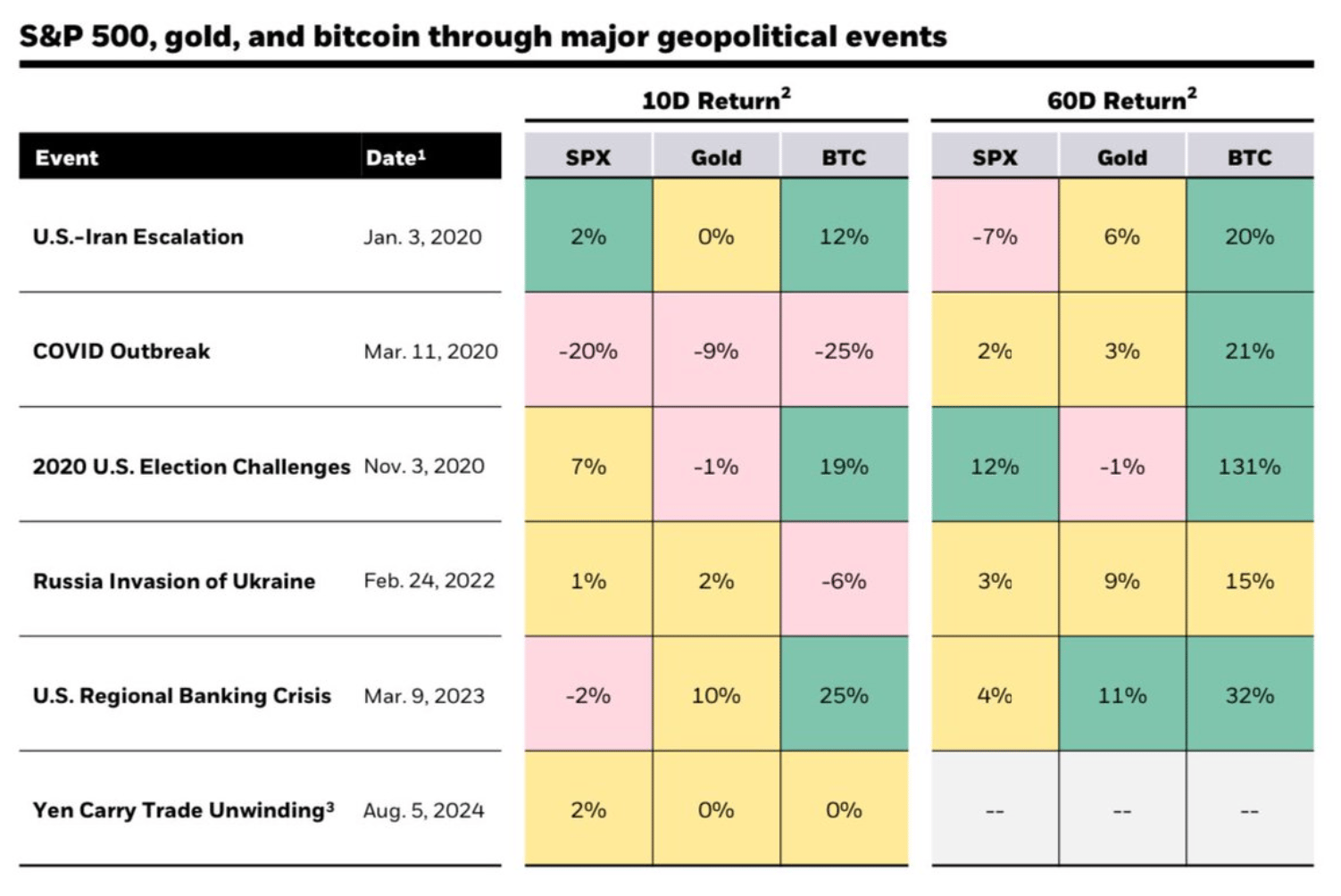
@BlackRock
BlackRock's research tells the real story: After the 2020 US-Iran escalation, Bitcoin (the column on the right of the above image) was up 20% sixty days later. S&P 500 was down 7%. Gold up just 6%.
Same pattern after COVID, the 2020 election, Russia/Ukraine, the banking crisis.
But catching the exact bottom? That didn't work. The long term winners however kept accumulating through the noise of COVID lows.
Bitcoin has now printed five consecutive red months, which is the 2nd longest losing streak since 2018. Six straight red weekly candles.
The opportunity isn't in timing the bounce. It's in stacking while the sellers run out of coins to sell (and it sure feels like that’s the case with war breaking out and Bitcoin holding up firmly).
2. What the Price Isn't Telling Us
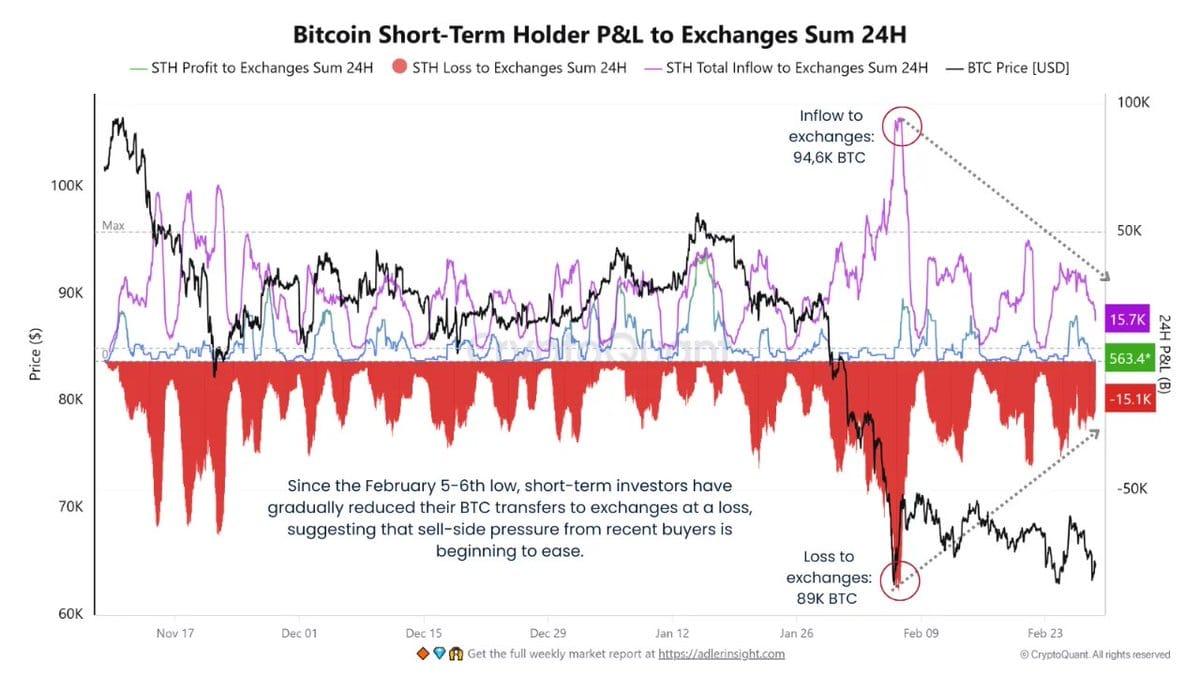
@CryptoQuant
Price: Down 47% from October highs. Five red months. Sentiment at historic lows.
Fundamentals: Quietly going parabolic.
The sellers are exhausted. CryptoQuant data shows short-term holders have gradually reduced BTC transfers to exchanges at a loss since the February 5-6 low.
The weak hands are out, and the overall macro picture is improving. February ISM Manufacturing came in at 52.4 (above expectations). Two straight months of expansion after a multi-month contraction. Historically, when ISM turns up, Bitcoin follows.
Adoption is accelerating. River's latest report tells the story:
3x the number of merchants accepting Bitcoin in the US
2.5x the number of businesses holding Bitcoin in treasury
60% of top US banks building Bitcoin products
300% growth in Lightning Network capacity
Five additional nation-states now holding Bitcoin
River's title explains it all very succinctly - "There is no bear market in Bitcoin adoption"
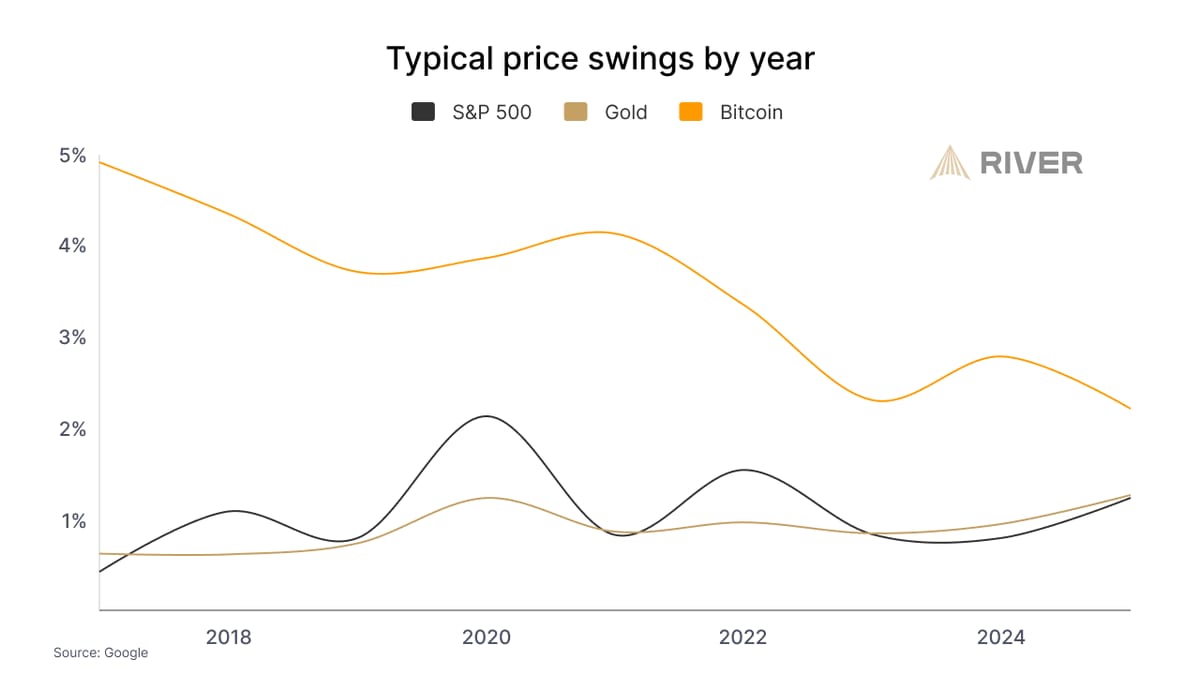
There’s also something in the report (which you can read here) that a lot of Twitter crowd initially missed. Bitcoin is no longer "too volatile" for portfolios.
@River
River's data shows Bitcoin is continuing a decade-long trend of declining volatility, now nearing that of gold and the S&P 500. Look at the chart, that gap is actually closing and closing fast.
Why is this worth monitoring at all? Well, as volatility falls, the hurdle for risk-averse investors declines. Pension funds, endowments, insurance companies (i.e. capital pools that couldn't touch Bitcoin five years ago are now running out of excuses).
The most recent bull market is evidence: Bitcoin attracted more investment in three years than in the rest of its history combined. And that was before volatility dropped to current levels.
The fear is priced in. The fundamentals are strengthening. But you won't see this staring at daily candles.
The market rewards conviction, not timing. Stack sats with the lowest fees through Rhino.
3. Who’s Left Buying and Why?
Strategy: Purchase #101
Saylor bought another 3,015 BTC for $204.1 million Monday. Strategy's 10th consecutive weekly purchase. They're sitting on $7 billion in unrealized losses and are now the most shorted stock in the market.
Saylor's response? "The Turn of the Century”. Keep buying.
Abu Dhabi: $1 Billion in IBIT
SEC filings show Abu Dhabi's sovereign wealth funds hold over $1 billion in BlackRock's Bitcoin ETF. They bought Q4 2025 while retail ran for the exits.
Iran: 700% Capital Flight
And then there's the story that proves Bitcoin's thesis in real-time.
Within minutes of the first US-Israeli strikes on Tehran, outflows from Nobitex surged 700%. This represents $3 million every single hour leaving through self-custody.
When bombs fell and the rial collapsed (down 2,280%), 11 million Iranians didn't decide to merely wait for their bank wires. They moved their wealth immediately in minutes.
As Elliptic's Dr. Tom Robinson put it: "The outflows potentially represent capital flight that bypasses the traditional banking system."
Gold can't do that. You can't send gold through the internet while bombs are falling.
That's who's buying. A corporate treasury $7B underwater. Sovereign wealth funds. And 11 million people using Bitcoin as an exit door from a war zone.
Which of these assets performs the best in the next 60 days? |
The Bottom Line
Five red months. Sellers exhausted. Macro improving. Institutional capital are once again stacking Bitcoin.
The bounce chasers are staring at charts. The stackers are accumulating at prices that will look obvious in hindsight.
As Michael Saylor put it: "The best time to buy Bitcoin was ten years ago. The second best time is now".
The price continues bleeding, but the fundamentals are moving in the opposite direction.
So my advice? Stop chasing bounces and start stacking sats.
Chat next Tuesday.
Hector
P.S. If there’s a woman in your life you want to introduce to Bitcoin, join us on March 4th and 5th for the first annual Bitcoin summit.
Sign up now [its 100% free]

How could we improve? |