- The Roundup
- Posts
- Price Is Flat. Asia Isn't.
Price Is Flat. Asia Isn't.
🇰🇷 South Korea lifts its 9-year corporate bitcoin ban. Strategy dodges a bullet. And ETFs enter "chopsolidation".

Hector Alvero
January 13, 2026

Good morning Bitcoiners, Hector here.
Look, I get it. Bitcoin's been stuck between $90K and $95K for what feels like forever. The chart's a flatline and your portfolio hasn't budged. It's tempting to tune out until something happens.
But realize that something is happening under the surface. You're just not seeing it in the price yet.
While we've been watching price candles go sideways, Asia has been quietly building the on-ramps for the next wave of substantial institutional capital inflows. This week we cover:
South Korea just ended a 9-year ban on corporate crypto investment.
Strategy survived its biggest institutional test yet.
U.S. ETFs are bleeding (but analysts say that's actually healthy).
Let’s break it all down.
1. Asia Opens the Floodgates
After nine years of saying "no", South Korea finally said "yes".
On January 12, the Financial Services Commission (FSC) finalized guidelines that allow listed companies and professional investors to invest in cryptocurrency for the first time since 2017!
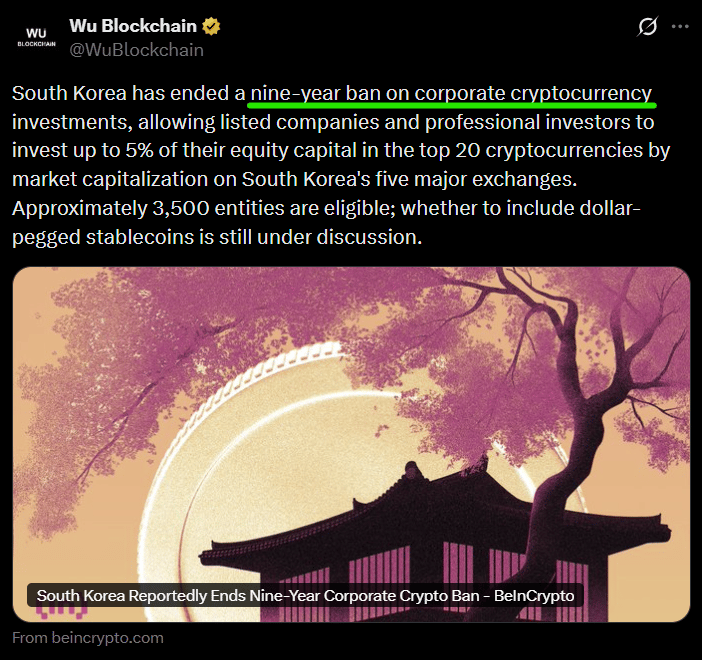
Source: @WuBlockchain
Here's what's changing:
~3,500 companies now eligible to participate
Up to 5% of equity capital can be allocated to “crypto” annually
Trading only on Korea's five major regulated exchanges
Final guidelines drop by February, with corporate trading expected later this year.
Why are we even covering this news? Well, look at Japan.
Japanese investors face a brutal tax regime: direct crypto gains are taxed as "miscellaneous income" at rates up to 55%. But Japan's NISA (Nippon Individual Savings Account) program allows tax-free investment only in ‘approved’ stocks - and guess which Bitcoin-heavy stock is NISA-eligible?
You guessed it, Metaplanet.
The Tokyo-listed company now holds over 35,000 BTC, and according to SBI Securities, it was the #1 most purchased stock in NISA accounts last year. Not Toyota, and not Sony, but a former hotel company that just buys Bitcoin.
CEO Simon Gerovich's formula? "Bitcoin + zero tax + leverage".
The game is simple: why pay 55% tax on direct Bitcoin when you can buy Metaplanet tax-free?
Korean investors watched from the sidelines for years.
Now 3,500 companies finally get to play.
🧠 Pop Quiz: Metaplanet's stock surged in 2024 after pivoting to Bitcoin. How much did it gain that year? |
2. Strategy Survives its Biggest Test (Yet)
While Asia opens new doors, Strategy (formerly MicroStrategy) just avoided having one slammed in its face.
On January 7, MSCI announced it would not proceed with a proposal to exclude "digital asset treasury companies" from its global equity indexes. MSTR stock jumped 6% on the news.

The backstory: MSCI had proposed excluding companies whose crypto holdings exceed 50% of total assets. With Strategy now holding 687,410 BTC (worth ~$62 billion), more than 3% of Bitcoin's total supply, they were squarely in the crosshairs.
Analysts estimated exclusion could trigger $8-15 billion in forced selling.
Executive Chairman Michael Saylor called the proposal "discriminatory, arbitrary, and unworkable" in a 12-page letter defending Strategy as an operating company.
MSCI agreed (but only for now).
But don't pop the champagne yet. MSCI explicitly said it plans a "broader consultation on non-operating companies" meaning the debate isn't over. The 50% threshold remains in place.
The battle was won. The war continues.
Congratulations if you've been stacking through the sideways chop. You're in good company. Want to add to your position? Get the lowest fees when you buy Bitcoin through Rhino.
3. ETF Flows: Welcome to “Chopsolidation”
Meanwhile, on Wall Street, the mood is... well, muted.
U.S. spot Bitcoin ETFs shed $1.1 billion over three consecutive trading days (Jan 6-8), nearly erasing all gains from the start of 2026. BlackRock's IBIT saw $193 million in outflows on January 8 alone. Fidelity's FBTC lost $120 million.

Sounds bad, right? Analysts say otherwise. CEX.IO's Illia Otychenko called it "normalization after stronger inflows" i.e. not a trend reversal.
CryptoQuant CEO Ki Young Ju put it bluntly: the market has evolved past "whale-retail dump cycles". The base case now is likely to be boring sideways “chopsolidation".
One number to watch: $79,000. That's the average purchase price of U.S. ETF holders, according to CryptoQuant. If Bitcoin hits that level, most ETF holders would be at break-even, potentially even triggering a new wave of selling.
But for now? The recent wave of selling is more likely to be the market catching its breath before the next move.
The Final Word
The price may be sideways, but the infrastructure is yet again going vertical.
Japan proved the demand, and now South Korea has opened the door. Strategy survived. ETFs held.
This is what the building phase looks like. It takes time and doesn’t involve fireworks all the time. Its just infrastructure rails being laid for the next wave of capital.
If you're waiting for clarity, this is what clarity looks like. Not a green candle, but institutions, nations, and regulators all moving in the same direction.
The next leg up won't be announced. It'll just arrive (as it typically does in Bitcoin).
Chat next week,
- Hector
P.S. Know someone still waiting for "the right time" to buy? Forward them this issue. The infrastructure doesn't wait for perfect entries.
How could we improve? |