- The Roundup
- Posts
- Real assets are bid, fake ones are questioned
Real assets are bid, fake ones are questioned
Hard assets break out while fake secondary markets get crushed.

Hector Alvero
May 12, 2026

Good morning all of my fellow Bitcoiners.
Last week we covered River CEO Alex Leishman’s thesis: stodgy banks, casino apps, and Bitcoin banking as the resolution.
This week we’re covering what Strategy’s CEO Michael Saylor said, and how Anthropic detonated a multi-billion dollar secondary market overnight.
Oh and remember that “hard assets” narrative?
Well, looks like it’s back in vogue again…
Here’s what we’re covering this week:
Why Saylor confirming Strategy "may sell" their BTC doesn't equate to "capitulation".
Anthropic telling $2 billion of tokenized "shareholders" that their ownership is null and void.
Why gold, silver, and uranium are all breaking out while Bitcoin chops.
1. Strategy's Treasury Just “Leveled Up”
Strategy released Q1 2026 results last week and the markets responded positively ($MSTR common stock is up now for SIX consecutive weekly candles since Bitcoin bottomed in late Q1).

They reported 818,334 BTC on their balance sheet, with a 9.4% BTC yield year to date.
They’ve raised $11.6 billion in 2026 so far, which makes Strategy the largest US equity issuer of 2026.
But the line that caught everyone by surprise was the below:
"We'll probably sell some Bitcoin to fund a dividend just to inoculate the market, just to send the message that we did it"
The market freaked out - the short sellers smelled blood and were quick to point out the reversal in stance by the man who told the market they would ‘never sell’ their Bitcoin.
What Saylor actually described however, was that his treasury can move capital in both directions. Strategy's STRC preferred shares scaled to $8.5 billion in just nine months and those shares pay dividends every quarter. Strategy has to fund them somehow.
And if they were to in fact sell the Bitcoin, they’d do so in a tax favored mechanism. The IRS classifies Bitcoin as property, so Strategy can sell coins they bought above current prices, book the capital loss, and offset future taxes.
CEO Phong Le spelled this out on the same call stating that the objective was to “sell Bitcoin purchased at higher prices than current levels to realize capital losses, potentially unlocking around $2.2 billion in tax savings”.
Pretty smart strategy if you ask me. This is exactly what we’d expect from a mature Bitcoin treasury management that places an emphasis on responding to market conditions rather than locked into the cult of hodling their Bitcoin forever.
Strategy still acquired 89,599 BTC in Q1 alone and they continue to accumulate - now they merely have added optionality.
In truth, all the maximalists that criticized Saylor for his change of stance will get over it quickly (looks like the market already has, with MSTR recovering from the initial dip within 24 hours).
Unlock Liquidity From your Rhino App
Need fiat without selling your stack?
Rhino customers can now access the lowest interest rates on Bitcoin-backed loans through our partner Arch Lending, directly in the Rhino app.

Keep your Bitcoin. Access your liquidity.
2. Anthropic Just Voided $2 Billion of "Ownership"
Anthropic published a support page this week that should send shockwaves through every "tokenize everything" pitch deck in Silicon Valley.

The exact language is below:
"Any sale or transfer of Anthropic stock, or any interest in Anthropic stock, that has not been approved by our Board of Directors is void and will not be recognized on our books and records."
Void. Not restricted or “pending review”, but Void.
Anthropic then named the platforms whose offerings they consider unauthorized.
Hiive. Forge. Open Door Partners. Unicorns Exchange. Sydecar. Upmarket.
If you bought "Anthropic shares" through any of these channels, your transaction is, in Anthropic's own words, invalid.
The secondary market for Anthropic shares is multi-billion dollar in nature.
Platforms have been pricing the stock at $265 to $1,400+ per share based on a $380 billion valuation. Real people have put real money into these positions across various tokenized platforms as well (including on other blockchains like Solana).

Now Anthropic have just told them none of it counts.
Now think about what this means for the broader "tokenize real-world assets" narrative that has fueled half of crypto's pitch decks.
Tokenized pre-IPO equity. Tokenized real estate. Tokenized private credit. Every single one of these structures depends on the underlying asset issuer recognizing the token as a legitimate claim.
Anthropic just showed, in writing, that the issuer can simply decline.
A token represents a claim. The claim depends entirely on whether the entity behind it agrees to honor that claim. As Casey Craig (@caseycraig) put it this week in one of his tweets, you are "approximately Anthropic-adjacent at best".
Pure counterparty risk, dressed up as innovation.
Bitcoin sidesteps this whole problem. When you hold Bitcoin, you hold Bitcoin, not a claim to Bitcoin held somewhere else.
No board of directors that can void your holding. The asset and the claim to the asset live in the same place: your wallet. That property is what makes Bitcoin so incredibly attractive to own as a truly sovereign asset.
3. Everything Hard Is Breaking Out. Bitcoin’s Turn Next?
While Bitcoin has chopped between $78K and $82K for most of the past month, the rest of the hard asset investment complex has been building momentum.
Three signals, all from the past week, that we’re tracking:
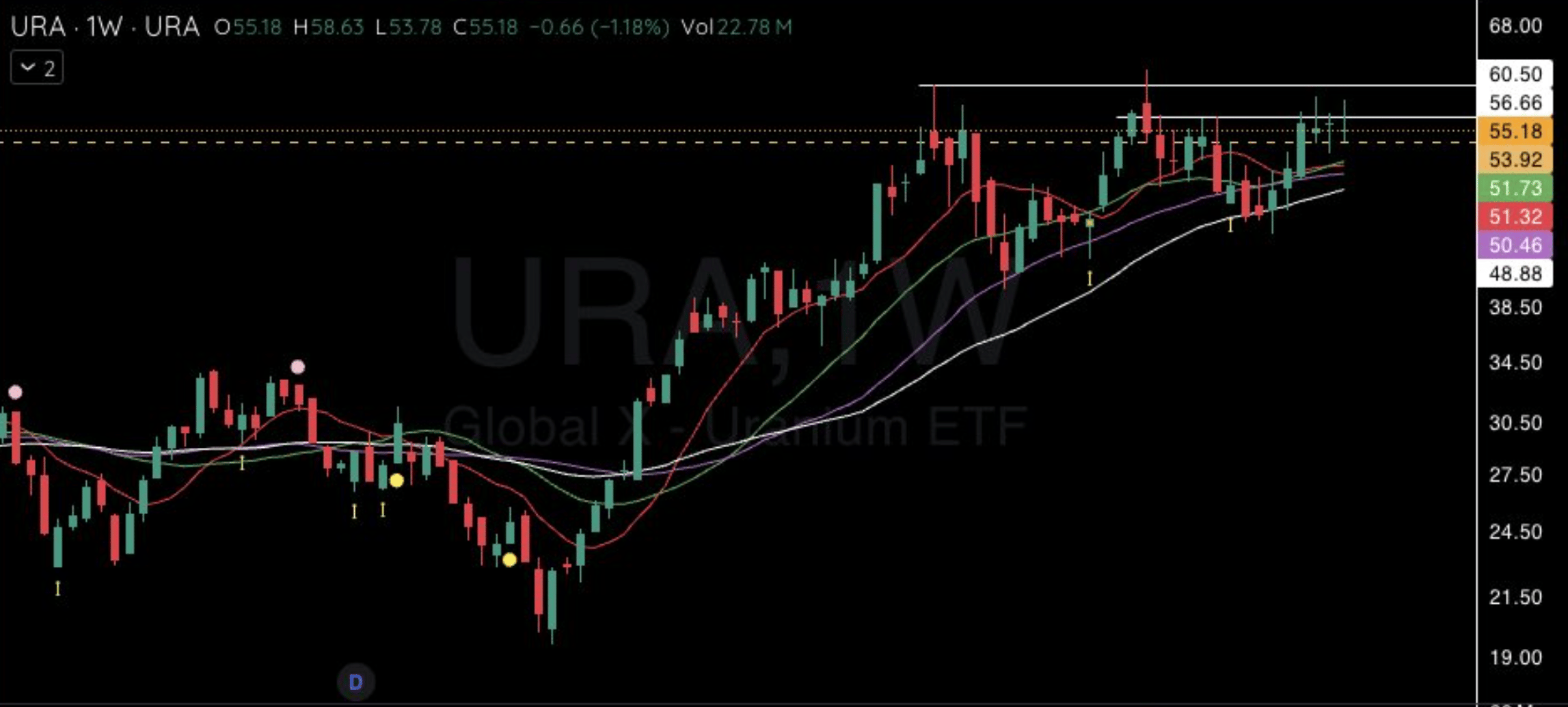
Uranium. All four major uranium ETFs (URA, URNM, NUKZ, NLR) just completed multi-week consolidation bases. Volume is building. Ted Zhang (@TedHZhang) flagged this morning that the structure in URA (the Uranium ETF, see below) looks like the kind of pattern that precedes sustained moves higher.
Gold. Barrick, the world's third-largest gold producer, just had its board authorize the repurchase of up to $3 billion of its own stock. Gold miners don’t just deploy $3 billion of cash to buy back their own shares unless they believe gold is structurally headed higher.

Silver. Otavio Costa (@TaviCosta) posted the daily silver chart below showing a clean breakout from a months-long consolidation wedge. His framing was that "Commodities never peak when structural demand is rising while both current and future supply remain heavily constrained".

Now compare to Bitcoin. While uranium, gold, and silver are all signaling continuation, Bitcoin has been in a tight $4,000 range for weeks.
Bitcoin is the only hard asset still consolidating while every other hard asset has already started moving.
Bitcoin typically tends to follow hard-asset rotations with a lag, and then catches up sharply. And the macro setup that is bidding gold, silver, and uranium is the same structural distrust of fiat that drives Bitcoin's best runs.
That distrust is showing up in mining-company buybacks and uranium accumulation right now. It has not yet shown up in Bitcoin's price.
For a Bitcoiner with patience and dry powder, that gap is the opportunity.
Which asset are you most bullish on in the next 6 months? |
The Bottom Line
Three stories and with the same conclusion.
Saylor is running a targeted Bitcoin sale to unlock $2.2 billion in tax savings and fund Strategy's preferred dividends. Anthropic is voiding multi-billion dollars of tokenized shares and reminding everyone that abstracted ownership has a counterparty. And every hard asset on earth is breaking out while Bitcoin sits unusually quiet.
The thread tying all three together is a return to fundamentals.
Real ownership matters. Real scarcity matters. And the market is repricing every asset based on which side of that line it sits on.
Bitcoin sits on the right side. The price has not yet reflected what the rest of the hard asset complex is already signaling. It usually does.
Stack accordingly.
Chat next week.
Hector
How can we improve? |