- The Roundup
- Posts
- When Miners Bleed, Smart Nations Buy
When Miners Bleed, Smart Nations Buy
⛏️ Hashprice hits record lows while El Salvador stacks another $100M and Strategy's yield mirage starts to crack

Hector Alvero
November 25, 2025

Welcome everyone to the latest edition of The Roundup,
This week on our list of topics we're covering👇
Bitcoin hashprice crashes to its lowest level ever recorded
Strategy's STRC "yield" isn't what Reddit thinks it is
El Salvador adds $100M to its Bitcoin stack while everyone else panics
Let's get into it!

Download the app today to learn about Bitcoin and earn free Bitcoin when you complete each learning module.
 |  |
1️⃣Bitcoin Hashprice Hits Record Lows - Bear Market Ahead?
Bitcoin's hashprice just crashed to $38.2 per petahash/second - the lowest level in over five years according to Luxor's index.
Before diving in, let's quickly define terms for those less familiar with mining economics:
Hashrate is the total computational power being used to mine Bitcoin and process transactions. Think of it as the collective horsepower of every mining machine on the planet competing to solve Bitcoin's cryptographic puzzles. The higher the hashrate, the more secure the network - and the harder it is for any single entity to attack it. Bitcoin's hashrate currently sits at record highs above 1.1 zettahashes per second (that's 1.1 sextillion calculations per second).
Hashprice measures how much revenue a miner earns per unit of that computing power. When hashprice drops, miners feel the squeeze to their bottom line.
Here's what's driving the current decline though:
Network hashrate remains at record highs. Difficulty sits near all-time highs at 152 trillion. Meanwhile, Bitcoin's price has dropped 30% from October's $126,000 peak, and transaction fees remain at bear market levels.
The result? Mining profitability is getting crushed from both sides - rising competition and falling revenue.
Source: @Luxor
The CoinShares mining ETF (WGMI) has fallen 43% from its peak. Many public miners have pivoted toward AI infrastructure to diversify revenue streams away from volatile Bitcoin rewards.
So - does this signal we’re entering a bear market?
Short-term: Not really. This is a temporary squeeze driven by price correction, not structural weakness. Miners who survived 2022 can survive this (especially the smaller ones with less bloated overheads than the Public miners).
Long-term: Worth monitoring. If hashprice stays compressed for extended periods, smaller miners capitulate, and network security could theoretically become more concentrated.
But we're nowhere near that scenario today (see below the “dip” in current hashrate over the long term on the right hand side of the chart).

The key takeaway here? Hashprice compression is a lagging indicator of price weakness - not a leading indicator of future doom.
Bitcoin's security model remains 100% intact. The network keeps producing blocks every 10 minutes with mathematical precision, regardless of what the price does.
2️⃣ Strategy's STRC: The "Yield" That Isn't
Strategy's STRC preferred stock has been bouncing around below its $100 par value for weeks - dipping as low as $88 before recovering to $96 this week. Reddit threads are now popping up touting STRC's 10.5% yield as attractive for dividend seekers and essentially "investment grade”.

Source: Reddit (Link here)
There's just one problem: it's not investment grade. Not even close.
S&P Global assigned Strategy a B- credit rating in October earlier this year (six notches below investment grade and firmly in institutional capital’s feared “junk bond” territory).
The rating agency cited "high bitcoin concentration, narrow business focus, weak risk-adjusted capitalization, and low U.S. dollar liquidity".
Translation? Strategy can service its debt for now, but remains vulnerable to Bitcoin’s volatility.
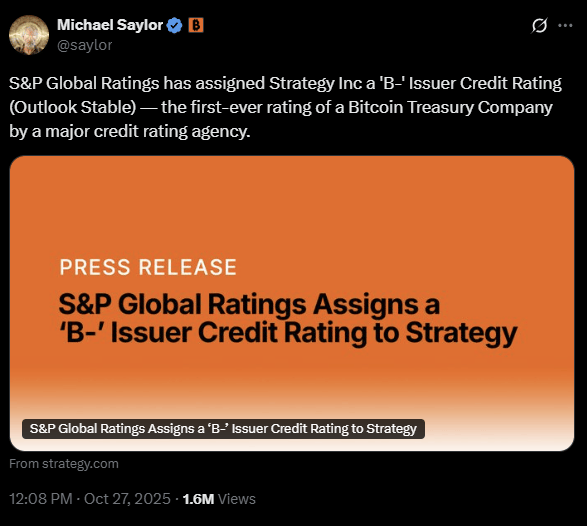
Source: @Saylor
Here's what these yield-chasers are missing: where does the yield actually come from?
Strategy doesn't generate enough operating income to cover its $640+ million in annual preferred dividends. Instead, it funds these payments by selling common shares through at-the-market (ATM) offerings. This dilutes existing shareholders to pay income to preferred holders.
Sound familiar? It should.
This is exactly the same dynamic as Ethereum’s staking "yield." ETH doesn't generate enough real profit, so what happens? You guessed it, the network issues new Ethereum to stakers - dilution dressed up as “income“.
Before chasing double-digit yields, always ask: "Is this real profit distribution, or am I just getting paid at the expense of someone else's ownership stake?".
With STRC, the answer is clear. You're not earning yield from productive enterprise. You're earning yield from equity dilution backed by a volatile asset.
What do you think the risk of STRC depegging is? |
3️⃣ El Salvador Buys the Dip While Everyone Else Panics
While retail traders dumped and ETFs bled $3.8 billion in November, one buyer stepped up: El Salvador.
President Nayib Bukele confirmed the purchase of 1,098 BTC last week - worth approximately $101 million at current prices. This represents the country's largest single acquisition since it began stacking sats in 2021.

Source: @nayibbukele
El Salvador's total holdings now stand at 7,474 BTC, valued at roughly $650 million.
The timing is classic Bukele. Bitcoin had just crashed below $90,000 (a seven-month low), and fear was everywhere in the market.
How much fear? More than the FTX collapse (where the fear and greed index dropped to as low as 12/100).

Source: Bitcoin News
Let that sink in. The Fear & Greed Index hit 9/100 this week - lower than the reading during the FTX collapse in November 2022. Back then, Bitcoin traded at $21k. Today it sits at $88k.
The price is 4x higher, but the fear is worse. That's the definition of irrational panic.
Bukele's response? A celebratory "Hooah!" on X.
The move technically conflicts with El Salvador's $1.4 billion IMF loan agreement, which discourages additional public sector Bitcoin purchases. But Bukele has made clear the buying won't stop "until the program ends".
This is Bitcoin adoption at its finest. While Western institutions worry about whether the AI bubble is about to pop, a small Central American nation continues building its sovereign wealth fund in the hardest money ever created.
El Salvador now controls nearly 7,500 BTC - more than most publicly traded companies.
Critics call it reckless. History may call it visionary.
🎯 The Final Word
This week showed us what happens when fundamentals meet fear.
Bitcoin's hashprice hit record lows - a temporary squeeze, not a structural crisis.
Strategy's STRC bounced back toward par, but investors chasing that 10.5% yield should understand they're getting paid through dilution, not profits.
And El Salvador reminded us that conviction matters more than consensus - buying $100M in Bitcoin when fear exceeded even the FTX collapse.
The pattern is now familiar. When panic sets in, there continues to remain a strong structural bid from those with long-term conviction; whether a small nation or a Harvard endowment.
Bitcoin miners will also adjust over time. Hashprice will recover. And Bitcoin will keep producing blocks whether the Fear & Greed Index reads 9 or 90.
How will you be positioned when it eventually hits the latter?
Chat next week,
The Rhino Bitcoin Team
P.S. El Salvador didn't ask the IMF for permission to buy 1,098 BTC at $90K. They just did it. Sometimes conviction means going against the mainstream sentiment and pulling the ‘buy’ trigger when others are fearful.
Start your own Bitcoin stack today with industry-low fees on Rhino available here (for iOS) or here (for Android).
⚡Lightning Round
Pick n Pay Customers Spend R14M Monthly in Bitcoin: South African retail giant reports growing Bitcoin payment adoption across its stores.
Bitcoin Miner CEO Admits to Being Hacked Earlier This Year: Industry executive confirms security breach in candid social media disclosure.
Solo Miner Beats 1-in-180 Million Odds for $265K Block: Hobbyist with just 6 TH/s of hashpower wins full block reward - proof that small players can still strike gold.