- The Roundup
- Posts
- When the Anchor Breaks
When the Anchor Breaks
🇯🇵 Japan's bond shock rattles global markets as corporate treasuries pump the brakes on new Bitcoin purchases

Hector Alvero
December 02, 2025

Japan just broke something that held together for 30 years. And Bitcoin felt it before anyone else did.
In this week’s edition of The Roundup, we’re covering 👇
Japan's bond yields hit levels not seen since 2008 (Bitcoin front ran this)
Corporate treasury buying falls to 2025 lows as Strategy faces a potential index exile
Bitcoin dips below production cost but holds above the one level it has never breached
Before we hop into it, quick poll - we want to know who's reading The Roundup 👇
What kind of Bitcoiner are you? |
1️⃣The Anchor Has Broken: Japan's Bond Shock Hits Bitcoin
For three decades, Japan was the anchor of global liquidity. Near-zero interest rates made the yen the world's favorite funding currency. Institutions borrowed cheap yen to buy US Treasuries, European bonds, and risk assets everywhere.
That era just ended.

Japan's 10-year government bond yield surged to 1.86% on Monday, its highest since April 2008. The 2-year yield crossed 1% for the first time in 17 years. Yields have nearly doubled in 12 months.
Bitcoin felt it immediately. BTC dropped 5% on Sunday evening as markets opened, sliding below $87,000 as over $640 million in leveraged positions were liquidated.
Why are we covering this? Well, Japanese institutions hold approximately $1.1 trillion (yes trillion with a “T”) in US Treasury bonds. When domestic yields rise from essentially nothing to nearly 2%, capital that flowed outward for decades faces pressure to come home.
And Japan isn't just a liquidity story, but rather a “canary in the coal mine”. When the world's most patient creditor demands real yield, every other global asset priced on "rates must stay low forever" has to reprice accordingly (BTC included). But unlike bonds, Bitcoin's supply doesn't expand when yields rise.
Swap markets are now pricing in a BOJ rate hike at the December 18-19 meeting. Bitcoin sits at the highest end of the risk spectrum, so even small shifts in global liquidity lead to sharp moves.
2️⃣ Treasury Buying Hits 2025 Lows
Remove one buyer and the corporate Bitcoin bid nearly disappears.
According to BitcoinTreasuries.net, public companies added just 12,600 BTC in November - the lowest monthly total of 2025. After accounting for sales, net additions dropped to only 10,720 BTC.

Only 12,600 BTC Bought in Nov ‘25
The uncomfortable truth most Bitcoiners won’t want to hear: Strategy accounted for nearly 75% of all corporate buying last month. Without Saylor, the institutional bid is barely a whisper.
And Strategy itself faces an existential threat. MSCI is considering removing Strategy from its equity indices on January 15th 2026. The index provider proposes excluding companies where digital assets comprise more than 50% of total assets.
Strategy, with 650,000 BTC worth $56 billion on its balance sheet, sits north of 90%. They're not borderline - they're the most extreme case.
JPMorgan estimates exclusion could trigger $2.8 billion in forced selling from passive funds. If other index providers follow, total outflows could reach $8.8 billion.
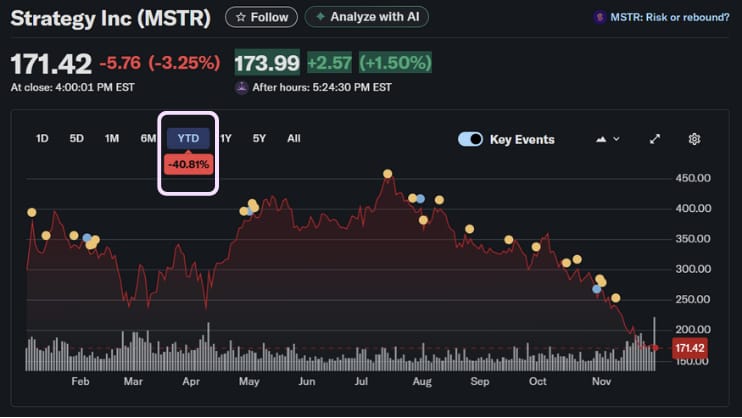
Saylor has pushed back, arguing Strategy is an operating company with a $500 million software business. But commentators increasingly believe removal is the base case. The stock is down 40.81% YTD while Bitcoin is down only 8%.
What are the odds Strategy's stock is excluded from the MSCI indices? |
3️⃣ The Floor That Has Never Broken
With all the macro doom, here's something worth remembering: Bitcoin has never sustained below its electrical cost to produce. Ever.
Capriole Investments tracks two key metrics. "Production Cost" is the all-in cost to mine Bitcoin. "Electrical Cost" is just the raw power bill at the end of the month.
Bitcoin's production cost sits around $89,000 while the electrical cost floor is approximately $71,000. With BTC near $86,000, we're below production cost but still above electrical cost.

Miner margins have compressed to 18%, one of the lowest readings of this cycle. But historically this is actually a stabilizing force. When profitability narrows, inefficient miners drop off, difficulty adjusts, and selling pressure (eventually) cools.
The logic is simple: if miners can't cover electricity bills, they shut off machines. Supply dries up.
When you buy below production cost, you’re actually buying at the price where supply itself starts to choke.
🎯 The Final Word
This week reminded us that Bitcoin doesn't exist in a vacuum.
When Japan's 30-year policy of suppressed rates cracks, the shockwaves hit risk assets first. When index providers question whether Bitcoin treasury companies belong in equity benchmarks, passive fund flows evaporate.
But zoom out. Bitcoin is trading near production cost for the first time since mid-2024 and the electrical cost floor still sits 17% below current prices.
The infrastructure is built. The institutions aren't leaving. The floor is closer than you think.
Chat next week,
Hector
P.S. When the world's most conservative central bank abandons three decades of policy in 12 months, "store of value" stops being a meme and starts being a necessity.
Start your own Bitcoin stack today with industry-low fees here (for iOS) or here (for Android).
⚡Lightning Round
Saylor's "never sell" policy has a kill switch: CEO Phong Le confirmed Strategy would sell Bitcoin if they run out of options to pay dividends.
BlackRock Bitcoin ETF Most Profitable Product: IBIT generates more revenue than BlackRock's S&P 500 tracker.
France Emerges as Hotspot for Wrench Attacks: Physical Bitcoin theft rising as criminals target known holders.